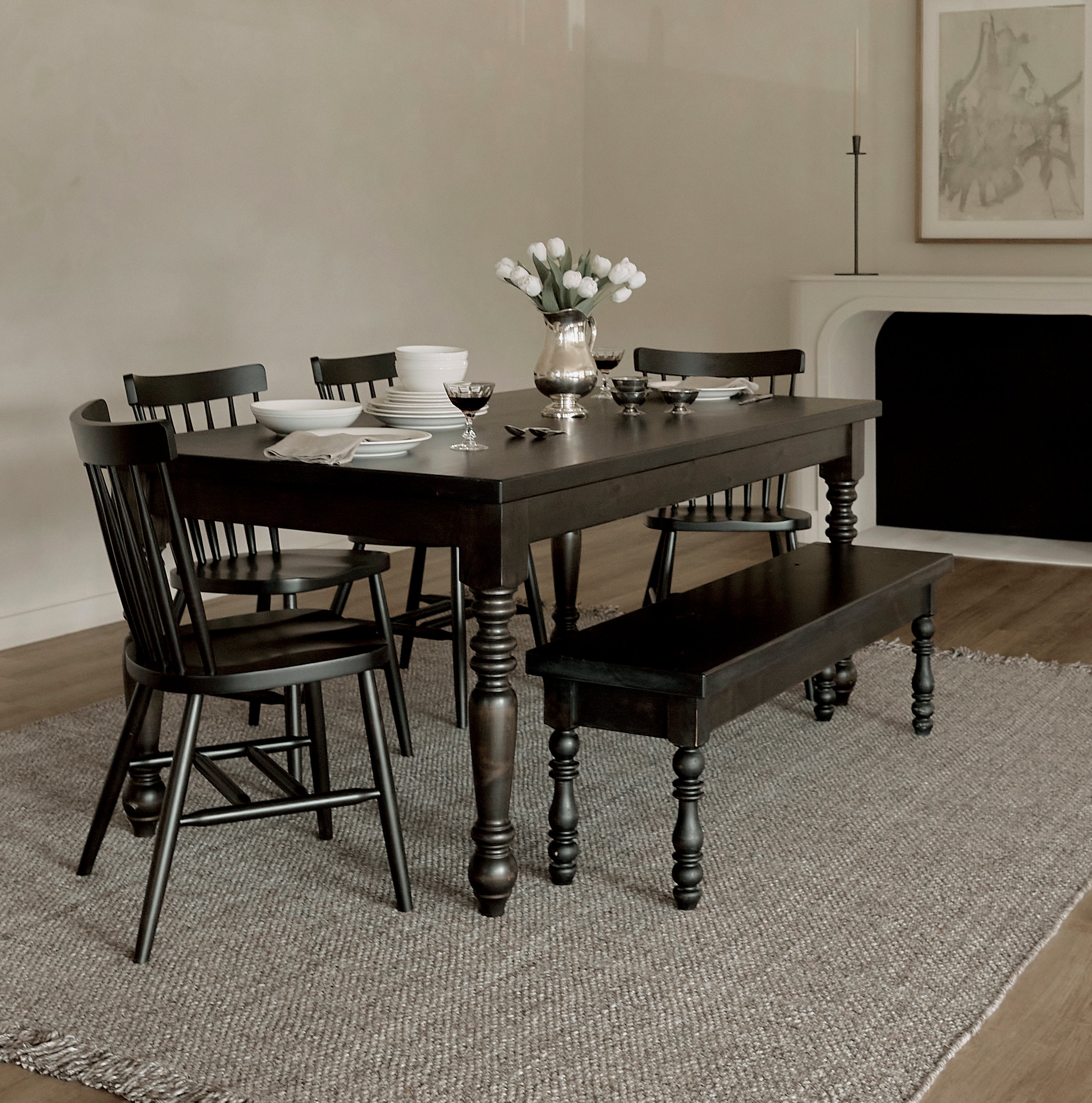
An extendable dining table solves a familiar tension in a well-lived home. You want the dining room to feel open and proportioned for everyday meals, but you also want to welcome family, holidays, and the kind of dinner that somehow gathers a few more people than expected.
The right table makes room for both. It feels settled when the household is small, then grows with ease when the occasion calls for it. That is not simply a feature. It is a way of choosing furniture around real life rather than asking real life to adapt to a fixed footprint.
Our extendable dining tables are made for homes that gather in different ways from one week to the next. This guide will help you decide whether an expandable table is right for you, how to choose its size and shape, what to confirm about its leaf and base, and how to select a material and finish you will be happy to live with for years.
Start With the Way Your Home Gathers
The first decision is not dimensions. It is rhythm.
Think about the dining room on an ordinary day. How many people use the table most nights? Does the room also serve as a homework station, workspace, or place to spread out a project? Do you value open floor space between meals? Then picture the moments when the room needs to do more: visiting family, holidays, birthdays, long Sunday dinners, or a gathering that carries on after dessert.
An extendable table is most useful when those two versions of life are meaningfully different. If the table needs to seat a large group almost every day, a substantial fixed table may be the simpler choice. If the room is used by a smaller household most of the time but regularly welcomes more people, an expandable table can give you the balance that a permanently oversized piece cannot. This is especially true if you're looking for an extendable dining table for an open concept home.
Choose for the days that happen most often
One common mistake is buying for the biggest dinner of the year and accepting a crowded room for the rest of it. A dining table should not make ordinary life feel like it is waiting for a holiday. The closed size needs to feel intentional, comfortable, and appropriate for the way the room works most days.
For some homes, that means a round table that creates an easy center for everyday meals. For others, it means a rectangular table that gives a longer room its natural structure. The table’s expanded configuration matters, but the everyday one is where you will live with it most.
Then plan for the moments that ask for more
The expanded size should be just as considered. Imagine chairs pulled back, people walking behind them, food moving from the kitchen, and the routes guests use to enter and leave the room. When the table is open, the space does not need to feel as spare as it does on a quiet Tuesday. It does need to remain comfortable and usable.
Before choosing, mark both footprints on the floor. Tape is useful, but so are boxes, a bedsheet, or the chairs you already own. Test the closed dimensions first, then the full expanded size. Open doors. Walk from the kitchen. Stand where a guest would sit. The room will tell you quickly whether the table creates flexibility or simply moves the crowding problem to a different day.
Decide Whether an Extendable Table Is Right for You
An extendable table is not automatically better than a fixed one. Its value comes from the difference it makes in your home. You may want to consider the pros and cons of extendable vs fixed dining tables.
It is a strong choice when the dining room needs two sizes
An expandable table can be especially useful for a smaller household that hosts regularly, a multi-purpose dining room, or an open-plan space where the table’s everyday footprint affects several rooms at once. It allows the dining area to remain calm and well proportioned most of the time, then become more generous when the guest list grows.
It is also a thoughtful option for people who do not want to choose between an intimate everyday meal and a larger family gathering. The table can support both without making either feel like a compromise. This is especially important when considering extendable dining tables for small dining rooms.
A fixed table may be better when large gatherings are your normal
If a large group uses the table every week, you may prefer a fixed table that is already at the size you need. There is a particular ease in arranging the room around one footprint: the rug, chairs, lighting, and circulation can all be planned around a stable configuration.
There is no virtue in expandability for its own sake. Choose it because it solves a recurring problem, not because it seems like the more versatile option on paper. this is especially true if you are considering an extendable dining room table for large families.
Ask what you want to manage
An extension leaf is part of ownership. It needs to be used, cared for, and, when it is not in the table, stored appropriately. For some households, opening the table before a celebration is a welcome ritual. For others, a fixed table feels more satisfying because it asks for nothing beyond everyday care.
Be honest about which experience you prefer. The best table is the one you will use gladly, not the one that sounds most adaptable in a product description.
Get the Size Right in Both Configurations
Size is the most important practical decision. An extendable dining table has two footprints, and both need to work in the room. Learn more about how to choose an extendable dining table size here.
Begin with the closed dimensions
The closed size should serve the people who use the table most often. Look at the room with chairs in place, not just the tabletop alone. Consider the depth of the chairs, the path behind them, doors, cabinetry, a sideboard, and the route to the kitchen.
On an everyday basis, the table should leave enough breathing room that the dining area feels inviting rather than fixed in place. This is particularly important in a home where the dining space is visible from a living room or kitchen. The table’s footprint becomes part of the larger view.
Plan just as carefully for the open size
When the table expands, it may become longer, change shape, or ask for more room around the perimeter. The collection’s product pages provide the specifications for each design, so use the exact measurements of the table you are considering rather than applying one universal rule.
For example, James & James’ Expandable Round Heirloom Dining Table is approximately 48 inches round when closed and expands to approximately 72 inches oval with its leaf inserted. That is a meaningful transformation—and a useful reminder that the open form needs to be planned as carefully as the closed one. Other tables have their own dimensions, shapes, and configurations.
Look beneath the top as well as around it
Overall dimensions are only part of the picture. The base, apron, leg placement, and clearance beneath the table influence where chairs can sit and how comfortable each place feels. A pedestal can offer more flexibility around the perimeter; a legged table can create the traditional structure you prefer while defining chair placement more clearly.
Review the specifications of the exact product before ordering. The table should make sense for the chairs you own or plan to choose, not just fit a rectangle on a floor plan.
Choose the Shape That Works With the Room
An extendable table’s shape affects the room twice: once when it is closed and again when it is open. The right form should feel natural in both states.
Round extendable tables
A round table can make everyday meals feel especially connected. There is no head of the table, guests face toward the center, and the absence of corners can make movement around the dining area feel easier. It can be a beautiful choice for a balanced room, a breakfast area, or an open-plan home where the table sits along a path between rooms.
When a round table expands, it may gain a longer form that accommodates more guests while retaining some of the softness that made the closed table appealing. If you are considering this option, compare the actual diameter, expanded shape, chair arrangement, and room required in each configuration. Consider round vs rectangular extendable tables.
Rectangular extendable tables
A rectangular table is often the natural fit for a longer dining room. It brings direction and structure to the space, provides a familiar seating arrangement, and can make sense for homes that host larger groups. When extended, it gives a long room more capacity without changing the room’s basic visual logic.
The important consideration is circulation along the sides and at the ends. An extended rectangular table needs enough room for chairs, serving, and movement without turning the dining room into a narrow passage.
Let the room lead, not the idea of maximum seating
Do not choose a shape because it appears to seat the most people in theory. Choose the one that lets people use the room comfortably. A round table may be the better everyday answer in one home; a rectangular table may make better use of another. The space, the paths through it, and the way you gather should decide.
Understand the Leaf Before You Order
The leaf is what turns an expandable table into a flexible one, so it deserves a practical conversation before purchase.
Confirm how the table changes
Read the product-specific information carefully. Confirm the closed dimensions, expanded dimensions, resulting shape, and the way the leaf is used for the exact design. Do not assume one mechanism or configuration applies to every table in the collection.
The right questions are straightforward: How large is the table in each form? How does the room work in both? What needs to happen before the leaf is installed? Who will normally set it up? A well-informed answer to those questions is more valuable than a generic comparison of leaf styles.
Plan where a separate leaf will live
If the leaf is stored separately, decide where it will go before the table arrives. James & James advises keeping a wooden leaf flat in a clean, cool, dry, shaded place rather than standing it upright. That kind of practical planning is part of choosing an extendable table with confidence.
The storage plan does not have to be elaborate. It simply needs to make the flexibility easy to use. A leaf that has a safe, accessible home is much more likely to be part of the way you gather rather than something you avoid using. Learn how to store an extendable dining table leaf.
Care for the leaf as part of the table
Wood responds to changes in its environment. Follow the care guidance for the product you choose, avoid forcing a leaf into place, and give it time to reacclimate if it has been stored separately and needs to adjust to the room. These small habits protect the table’s finish and help the extended configuration remain enjoyable to use over time.
Choose a Base That Supports Your Seating Plan
The base is easy to overlook when you are focused on the mechanism, but it plays an important role in how the table works day to day.
Pedestal bases can create flexible seating
A pedestal base can make it easier to position chairs around the table because there are no corner legs to navigate. This can be especially useful for a round table or for a household that expects chair placement to change as the guest list does.
That flexibility does not make a pedestal universally better. The visual weight, tabletop size, and room proportions still need to feel right. But if seating flexibility is a priority, the base deserves to be part of the conversation early. There is a lot to consider when looking at pedestal vs legged extendable dining tables.
Legged tables create familiar structure
A four-leg table can bring a classic, grounded presence to a dining room. It may be exactly the right choice for a longer room or a more traditional setting. Just consider the relationship between legs, chair positions, and the expanded length before finalizing the design.
The goal is not to choose the base that appears most open in isolation. It is to choose the one that gives your guests comfortable places to sit in both configurations.
Choose Wood and Finish for the Home You Have
An extendable table remains the visual center of the dining room whether it is open or closed. Its wood, finish, and style should feel right in both roles.
Let natural material carry the warmth
James & James expandable dining tables are crafted in solid hardwood and made to order. The available materials and finishes vary by design, which makes it important to confirm the options for the exact table you want. Some current collection options include oak and alder finish directions, each with a different relationship to light, grain, flooring, and surrounding furniture.
Do not feel pressured to match every wood surface exactly. A dining table can relate to cabinetry and floors through warmth, contrast, or texture rather than identical color. The best finish is often the one that makes the entire room feel more considered.
See the finish in your own light
Screens and showroom images cannot fully show how a finish will read beside your floor, walls, cabinetry, and upholstery. James & James offers wood and upholstery samples so you can compare real materials in the room where the table will live.
Place samples near the dining area. Look at them in daylight and evening light. Compare them with chair fabrics, the rug, and the floors. An extendable table is meant to stay with you for years; taking time with the finish is part of making that decision last.
Choose style that remains at home in both forms
The table’s silhouette, base, and finish should feel as convincing when it is open as when it is closed. A richly finished, traditional table can become a warm anchor for a formal dining room. A lighter, cleaner design can keep an open-plan home feeling calm. A farmhouse form can bring welcome character to a newer space; a more restrained table can let natural materials and architecture breathe.
Choose the style that belongs with your home rather than the one that follows a label most closely. The right table will feel natural in the room before guests arrive and generous once they do.
Know What to Look for in Long-Term Quality
An extendable table should not feel like a compromise in craftsmanship. The extension function matters, but so do the material, construction, finish, dimensions, and care guidance that shape how the piece will live in the home. Know what to look for in a solid wood extendable dining table.
Choose a table made for everyday use
James & James builds its furniture to order in solid hardwood. Its product pages describe hand-applied finishes protected with a polyurethane topcoat for everyday use, and product specifications identify the details that matter for the individual design. Those are the kinds of specifics worth reviewing before you purchase: what is the table made from, what finish is applied, what dimensions and clearances apply, and how should the piece be cared for?
The right answer will be specific to the table you choose. A good buying decision is not based on broad promises; it is based on a clear understanding of the piece that will arrive in your home. You should also consider how to choose an extendable dining table for entertaining.
Customization should solve a real problem
Custom size, stain, and finish options are most valuable when they make the table work better for your room. A slightly different length may preserve a walkway. A considered finish may connect the dining area to the kitchen. A particular shape may make the expanded size feel natural rather than crowded.
Treat customization as a way to create the right fit, not simply as a longer list of options. If you need help comparing dimensions, finish, or design details, James & James offers design consultations by phone or video. That includes how to choose dining chairs for an extendable table.
Questions to Ask Before You Choose
Before selecting an extendable dining table, ask:
- How many people use the table on an ordinary day, and how many do we host regularly?
- Does the closed size make the room feel open and comfortable?
- Does the expanded size still allow chairs, movement, and serving space?
- Which shape works best in the room when the table is closed and when it is open?
- How does the exact table extend, and what are its product-specific dimensions in both forms?
- If the leaf stores separately, where will it live safely and accessibly?
- Does the base allow the chair placement we need?
- Have we confirmed available wood, finish, and customization options for the table we want?
- Have we viewed samples in the light of our own home?
When you can answer those questions, you are ready to compare designs with real confidence.
Explore Extendable Dining Tables Made for Life
The right extendable dining table gives your home room to change without losing the proportion and warmth that make the dining area feel settled. It is there for quiet meals, the sudden extra place setting, and the gatherings that ask the room to become more generous.
Explore our extendable dining tables to compare solid hardwood designs, shapes, finishes, and made-to-order options for your home.
Frequently Asked Questions
Are extendable dining tables worth it?
They can be an excellent choice when your household needs a smaller everyday footprint but regularly hosts more people. The value depends on whether both the closed and expanded sizes work comfortably in your room.
How do I choose the right extendable dining table size?
Plan for both configurations. Mark the closed and expanded dimensions on the floor, include the chairs, and test the paths around the table. Review the exact product specifications before making a final decision.
Are round or rectangular extendable dining tables better?
Choose based on the room’s proportions and how people move through it. Round tables can create an easy conversational center and softer circulation; rectangular tables often suit longer rooms and larger gatherings. Compare the exact open and closed forms of each design.
What should I consider about a dining table leaf?
Confirm the table’s exact leaf configuration, its dimensions in both forms, how it is used, and where it will be stored if it is separate. Follow the maker’s care guidance and plan for the leaf before ordering.
Can I customize an extendable dining table?
James & James pieces are made to order, and available size, stain, finish, and material options vary by design. Review the individual product page or speak with the team to confirm the choices available for the table you are considering.