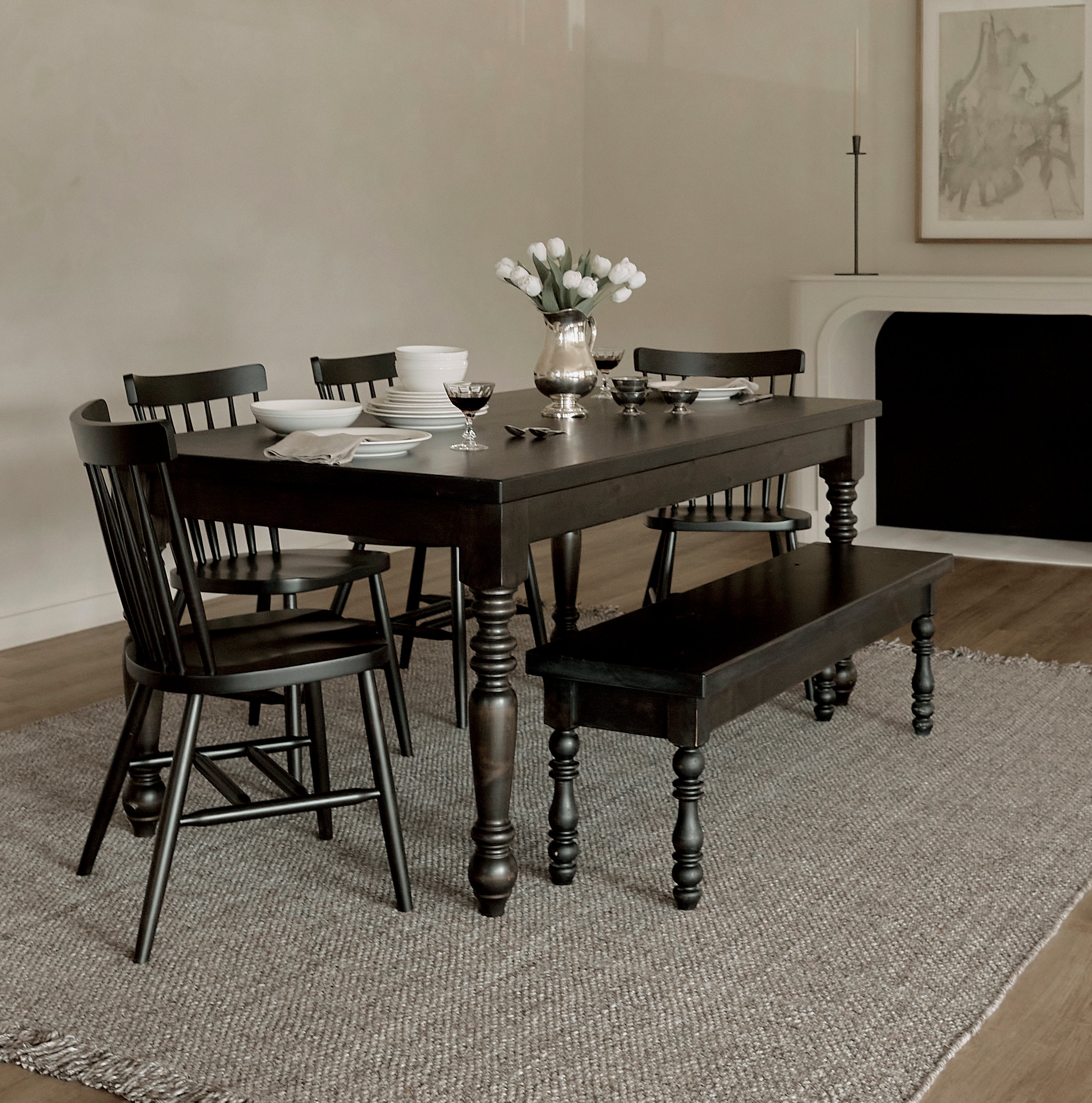
An extendable dining table and a fixed dining table can both be beautiful, lasting choices. The difference is not simply whether one has a leaf. It is the role you want the table to play in your home every day—and the role you need it to play when the house fills up.
A fixed table offers certainty. Its proportions are always the same, its silhouette is uninterrupted, and the room can be arranged around a single, dependable footprint. An extendable table offers a different kind of confidence: the ability to keep the room open on an ordinary day while making space for family visits, holidays, and dinners that grow beyond the original guest list.
The right choice begins with an honest look at how you gather. Browse our expandable dining tables.
The Real Difference Between Extendable and Fixed Dining Tables
A fixed dining table has one purpose-built size. You choose it because that size is right for the room and the people who use it. There is a certain ease in that decision: no leaf to store, no expanded configuration to plan for, and no reason to compromise the table’s everyday proportions for a hypothetical occasion.
An extendable dining table is designed for two rhythms of life. In its everyday size, it can feel calm and appropriately scaled for the household. When more people arrive, it can expand to make room for them. That flexibility is valuable when the difference between a weeknight dinner and a holiday meal is substantial.
Neither is automatically more practical. An extendable table can be the better choice for a small dining room that hosts regularly. A fixed table can be the better choice for a larger room where a generous table will be used and enjoyed every day. What matters is how often the larger configuration will genuinely serve your life.
Choose a Fixed Table When the Everyday Size Is the Right Size
A fixed table is often the most satisfying choice when your regular seating needs and your hosting needs are close together. If four, six, or eight people gather around the table often enough that a larger footprint never feels excessive, a fixed design can give the room a wonderful sense of permanence.
It is also a strong choice when you have already found the dimensions that make the room work. In a dedicated dining room with comfortable circulation, a fixed table can become the stable center of the space. You do not need flexibility for its own sake; you need the right proportion.
Fixed tables simplify the room
With a fixed table, the arrangement is easy to understand. The rug, lighting, chairs, and sideboard can all be planned around one size. There is no need to decide where guests will pass when the table is open or whether an expanded leaf blocks a door, cabinet, or natural path through the home.
That simplicity can be especially appealing in a room that already has a strong architectural layout. If the table’s everyday dimensions create a balanced composition, a fixed table allows you to enjoy that decision without planning for a second version of the room.
A fixed table can be the better choice for frequent hosting
It may seem counterintuitive, but a fixed table can make more sense than an extendable one for people who host large groups often. If you gather a crowd every weekend, the larger configuration is not an occasional convenience—it is your normal. A table that is already sized for that life can feel more natural than one that needs to be changed before every dinner.
Before choosing, ask whether you would rather live with a larger table all week or take a few minutes to extend it before the gatherings that matter. Your answer is often the clearest sign of which option belongs in the room.
Choose an Extendable Table When Your Needs Change Often
An extendable table is most useful when you need two genuinely different sizes. Perhaps the household is small most of the time, but family visits are frequent. Perhaps you want the dining room to remain open for work, play, or conversation during the week, yet need more seats for holidays. Perhaps the room itself is compact, but gathering is an important part of your life.
In those situations, the value is not simply extra seating. It is the freedom to let the room be spacious when it can be, then generous when it needs to be.
An expandable table protects the everyday footprint
One mistake buyers make is choosing a permanently oversized table because they are planning for the biggest dinner of the year. The result can be a room that feels crowded on the other 350 days. An extendable dining table lets you choose a more comfortable everyday footprint without giving up the ability to host when it matters.
James & James’ expandable collection includes tables in a range of shapes and styles. The exact extension design, material options, and dimensions vary by product, so the final decision should always come from the product page for the table you are considering. That specificity matters: an extendable table should feel considered in its closed form and its open form.
It can make a multi-purpose room work harder
In many homes, the dining room is not used only for dinner. It may be the place where a child does homework, where a laptop comes out in the afternoon, or where the visual connection between kitchen and living room needs to stay open. A table that expands only when needed can give the room more freedom the rest of the time.
This is particularly useful in open-plan homes. A large fixed table can dominate the view from several rooms, while a more measured everyday size lets the architecture and the rest of the furniture breathe. When friends or family arrive, the table can do what it is meant to do: make the gathering feel welcome.
Plan for the Expanded Size, Not Only the Closed Size
An extendable table does not solve a space problem if it only fits when it is closed. The expanded size needs the same careful planning as a fixed table: chairs need room to pull back, people need a clear route through the room, and nearby doors or cabinetry still need to function.
Before you choose, mark both footprints on the floor. If the table expands lengthwise, mark the closed length first, then the full length with the leaf in place. Add chairs around both versions. Walk from the kitchen. Open the door that sits nearby. Look at the room from the living area if the dining space is open to it.
This exercise is more valuable than any generic rule of thumb because it reveals how the table will work in your home. The expanded configuration does not need to feel as open as the everyday one. It simply needs to remain usable, comfortable, and worth the change.
Confirm the exact extension details
Not all extendable tables expand in the same way. Some change length, some change shape, and each product has its own dimensions and leaf configuration. James & James, for example, offers an expandable round table that changes from an approximately 48-inch round to an approximately 72-inch oval when its leaf is inserted. That can be a remarkable transformation for the right room, but it is not a universal measure for every extendable table.
Read the specifications for the exact design. Confirm its closed dimensions, expanded dimensions, overall shape in each configuration, and the practical room needed around it. Those details should drive the decision more than the label “extendable” alone.
Think About Leaves as Part of Ownership
The leaf is not an inconvenience, but it is part of how you will live with an extendable table. Before choosing one, think about when you will use it, where it will live when it is not in the table, and who will be responsible for setting it in place before a gathering.
If the leaf is stored separately, make sure there is an appropriate place for it: flat, clean, dry, and out of direct sun or large temperature swings. The point is not to create another household task. It is to make sure the added flexibility remains easy to use when you need it.
For some households, the ritual of opening the table before a holiday meal becomes part of the occasion. For others, a fixed table is more appealing precisely because there is nothing to manage. Both preferences are reasonable. The better one is the option that you will use without hesitation.
Let Style and Proportion Matter Too
An extendable table should not feel like a functional compromise. It is still the visual center of the dining room, and its material, finish, base, and overall presence need to suit the home. The same is true of a fixed table: its permanence makes the design decision even more important.
Start with the shape that suits the room. A round expandable table may be ideal for a smaller everyday gathering that occasionally needs more length. A rectangular extendable table can serve a longer room and accommodate a larger group when opened. A fixed oval or square table may give the room exactly the balance you want without the need for a leaf.
Then consider the wood and finish alongside the rest of the home. James & James offers made-to-order dining tables in solid hardwood, with finish options selected to work with the natural character of the wood. Viewing samples in your own light can make the choice feel much more certain, especially in an open space where the table relates to cabinetry, flooring, and upholstery nearby.
Questions to Ask Before You Decide
Choose the table that gives you the clearest “yes” to these questions:
- How many people use the table most weeks?
- How often do we need more seating than that?
- Does a larger fixed table feel right in the room every day?
- Does the room remain comfortable when an extendable table is fully open?
- Have we checked the exact product dimensions and leaf configuration?
- If a leaf is stored separately, do we have an appropriate place for it?
- Do we value an uninterrupted everyday silhouette more than the flexibility to expand?
If your answers point to a room that needs to change with the occasion, an extendable table may be the better investment. If they point to a room whose best size is already clear, a fixed table can be wonderfully simple.
Find the Dining Table That Fits the Way You Gather
The best dining table is not defined by a mechanism. It is defined by how easily it supports your life: quiet meals, long conversations, busy family weeks, and the evenings when there is always one more chair to pull up.
Explore our expandable dining tables if flexibility is what your home needs to find a shape and proportion made for your everyday life.
Next, read How to Choose an Extendable Dining Table Size.
Frequently Asked Questions
Is an extendable dining table less sturdy than a fixed table?
The important question is the construction and specifications of the exact table, not the category alone. Review the product details, materials, and extension design for the piece you are considering, and choose a maker that can clearly explain how the table is built and used.
Should I buy a fixed table if I only host large groups a few times a year?
Usually, begin with the size that makes your room feel right most of the time. If occasional larger gatherings matter, an extendable table may offer the better balance—provided the room also works comfortably when it is expanded.
Do I need to plan for the expanded table size before I buy?
Yes. Mark the expanded footprint on the floor, include chairs, and test the paths around it. The table should be usable in both configurations, not only in its everyday size.