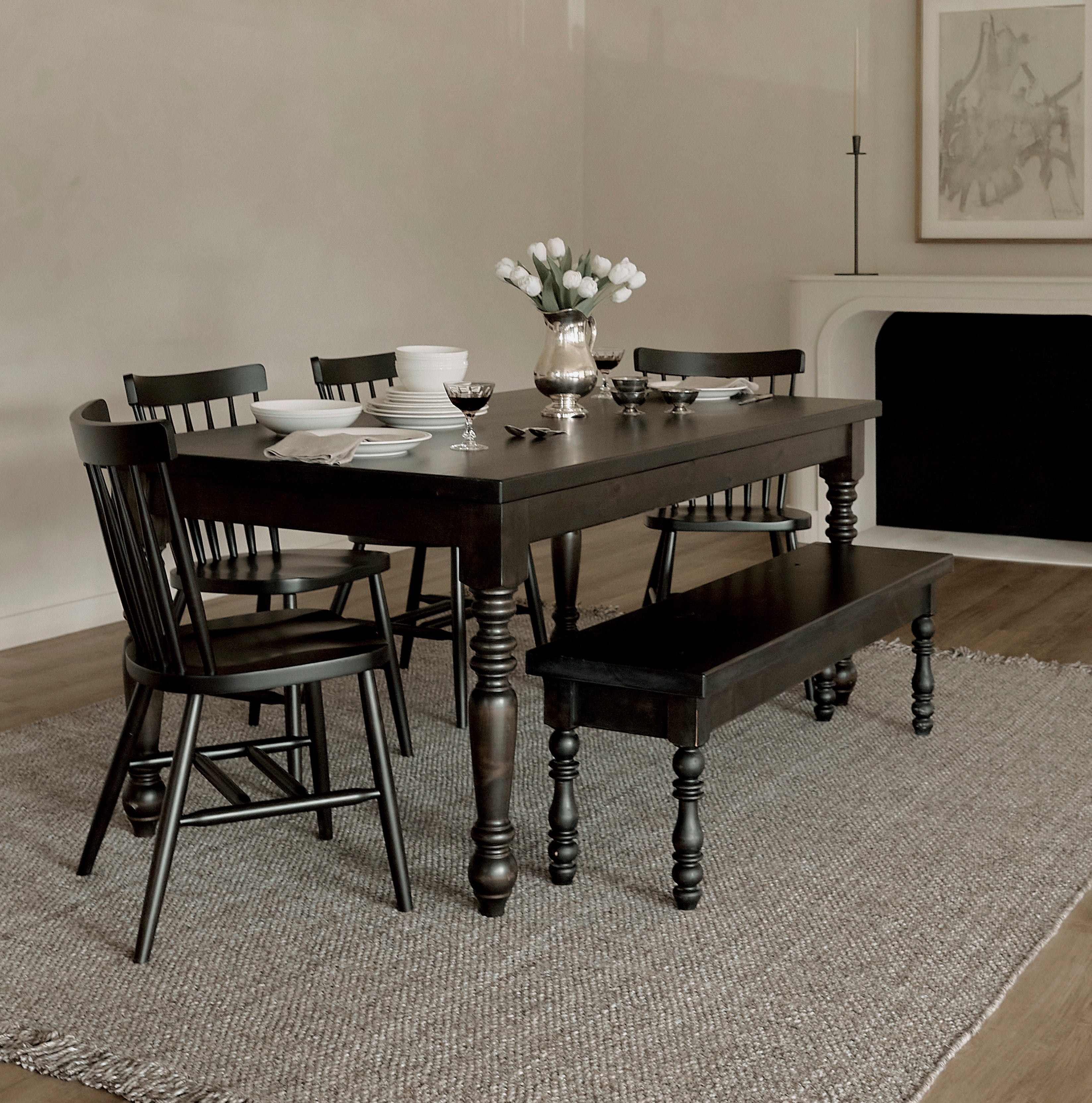



A dining table has a way of becoming more than the place where meals happen. It holds weekday breakfasts, half-finished schoolwork, dinner with friends, and the conversations that linger after everyone has cleared their plates. When you are choosing a piece for that kind of life, the right answer is rarely the first table that catches your eye.
The most satisfying choice begins with a clearer question: What does your home need this table to do? A table that feels beautifully proportioned in a quiet dining room may need to work differently in an open-plan kitchen, a home that hosts often, or a room that serves several purposes in one day.
Our collection of solid wood dining tables is made for those decisions. Each piece is built to order in solid hardwood and can be tailored in size, stain, and finish. This guide will help you weigh the choices that matter most—how you live, the shape and scale of the room, the character of the wood, and the flexibility you may value years from now.
Start With How Your Home Actually Lives
It is tempting to begin with a style: a turned leg you love, a pedestal base, a finish that caught your eye. Start one step earlier. Think about the table in use on an ordinary Tuesday.
Does it need to accommodate a family dinner every night? Does someone use the dining room as a workspace during the day? Is it the place where children spread out projects, where neighbors gather for coffee, or where every holiday seems to end up? The more honestly you answer those questions, the easier it becomes to choose a table that will feel natural rather than merely beautiful. Choose the right dining table size for your home.
Consider the room’s rhythms
Walk through the room as you normally would. Notice the route from the kitchen, the door that opens nearby, the sideboard that needs to remain accessible, and the places where chairs will move in and out. A dining table should give people a place to gather without making the rest of the room work harder.
For an open-concept home, the table also plays a visual role. It may be seen from the kitchen or living area every day, so its silhouette and finish need to feel at home with the materials around it. In a formal dining room, you may have more freedom to choose a more substantial shape or a more expressive base. Neither approach is better; they simply ask different things of the furniture.
Plan for the life you expect to live there
Buying for the next few years alone can be a false economy. If the table will be part of your home for decades, consider the gatherings you expect to grow into: new family members, visits from grown children, regular Sunday dinners, or the simple pleasure of having room when a meal becomes an evening.
That does not mean every household needs the largest table possible. A too-large table can make a room feel crowded and formal when what you really wanted was ease. The goal is to choose a scale that suits your daily life, then decide whether flexibility is worth building in for the occasions that ask for more.
Choose a Shape That Fits the Room and the Way You Gather
Shape changes more than appearance. It influences how people circulate around the table, how the room feels from the doorway, and how naturally conversation happens once everyone is seated. Begin with the room’s proportions, then let your preferences guide the final choice. Consider round vs rectangular dining tables.
Rectangular dining tables
A rectangular table is a natural fit for many longer dining rooms. It gives a familiar, orderly seating arrangement and can make good use of a room that has more length than width. It is often the easiest shape to scale for a larger group, particularly when the room has a clear path around its perimeter.
The important consideration is not just the table’s overall length. Look at the space between the legs or base, the room needed for chairs, and whether people can still move comfortably behind a seated guest. On a custom table, those construction details can affect how the piece functions as much as the outside dimensions do.
If a longer, more linear footprint suits your room, explore rectangular dining tables with the dimensions and base style that fit the way you entertain.
Round dining tables
A round table can make a dining area feel immediately more conversational. Everyone faces inward; there is no visual hierarchy at the ends; and the absence of corners can make movement feel easier in a compact or circulation-heavy space.
Round is not automatically the right answer for every small room. Its diameter still needs to leave comfortable space for chairs and movement. But when a room is relatively balanced in shape—or when you want to soften a space filled with straight architectural lines—a round table can create a warm, easy center. Explore round dining tables if that kind of gathering feels more like your home.
Oval dining tables
An oval table often gives you the best qualities of two familiar shapes: the generous length of a rectangular table with a softer outline that can improve the flow around it. It can be especially appealing in a long room where sharp corners would feel too dominant, or in a space where you want the table to feel inviting from several directions.
The trade-off is simply one of fit. An oval table still needs enough length and width to seat the people you have in mind, and its curved ends should complement—not obstruct—the paths through the room. See the current range of oval dining tables to compare proportions in more detail. Consider oval vs rectangular dining tables for your space.
Square dining tables
Square tables create an intimate, balanced arrangement for guests. They tend to feel especially right in a room that is close to square, where a long rectangular form would leave awkward empty space at either end. They can also turn a meal for four, six, or a close-knit group into a more connected conversation.
As the guest count increases, however, a square table grows in both directions. Before choosing one, picture the full footprint with chairs pulled back and people moving around it. For homes that value symmetry and face-to-face gathering, square dining tables are worth a closer look. Checkout our square vs round dining table buying guide.
Get the Size Right Before You Fall in Love With a Design
The right dimensions begin with the room, not a standard chart. There is no universal size that works for every dining room because the surrounding furniture, doorways, chair style, and traffic paths all change the usable space.
Start by marking out the approximate footprint of the table you are considering. Painter’s tape on the floor, a few boxes, or even a sheet cut to size can reveal more than a plan viewed on a screen. Pull chairs into the arrangement. Open the nearby door. Walk from the kitchen to the dining room. This small exercise often clarifies whether you need a narrower table, a shorter length, a different base, or a shape that leaves the room feeling more open.
Think beyond the tabletop
The dining experience happens around the table as much as on it. Allow for the depth of the chairs you are considering, the room a person needs to sit and stand, and any sideboard, rug, or doorway nearby. A table with a pedestal can feel more flexible for seating in some layouts because it removes corner legs; a four-leg table may offer the architectural presence you prefer while asking for more attention to where the chairs land.
With James & James, the dimensions of many tables are selected to suit your space. Product pages provide the specifications that matter for a particular design, including the practical clearances created by its apron or leg placement. Use those measurements—not only the overall length and width—when you compare options.
Choose for ordinary days and exceptional ones
Count the people who will use the table most often, then the number you hope to host comfortably. Those are two different numbers in many homes. You may find that a fixed table is exactly right for both. Or you may decide that your everyday table should feel more restrained, with an extension option for the occasions that call for more room.
The most thoughtful choice is not always the biggest table that can fit. It is the one that gives the room the right balance of generosity and ease.
Select a Wood and Finish for the Character You Want to Live With
Wood brings a kind of variation that manufactured surfaces cannot imitate. Grain, tone, and natural movement give a table its own presence, and those qualities become part of how the room feels over time. The best choice is not the one that matches every other wood surface exactly. It is the one that relates well to the rest of the home and still feels like itself. Choose the right dining table finish for your home.
James & James dining tables are offered in solid hardwood options including oak and knotty alder, with availability varying by design. The collection also offers a range of hand-finished tones. Before committing, review the exact product page for the table you are considering; material, finish, and customization options should be confirmed for that piece.
Oak and knotty alder: look at the character, not just the color
White oak often appeals to homeowners looking for a clean, quietly textured grain and a finish that can feel light and architectural or deeper and more traditional, depending on the tone selected. Knotty alder has a different visual language: warmer variation, more rustic character, and a sense of informality that can make a dining room feel especially lived in. Some people consider White Oak vs Walnut dining tables too.
Neither material needs to dictate one particular style. The surrounding room does more of that work. An oak table can sit beautifully with traditional pieces when the silhouette and finish are considered; an alder table can feel restrained and refined when paired with clean lines and a calm palette. What matters most is whether you enjoy the natural character you will see every day. Review our Oak vs Alder Dining Table buyers guide.
Let finish respond to light and surrounding materials
Finish is more than a color choice. The same stain can read differently beside warm or cool flooring, morning or afternoon light, pale walls, dark cabinetry, and the upholstery around the table. That is why real samples are so useful. They allow you to see a finish in the room where the table will live rather than under showroom or screen lighting.
James & James offers wood and upholstery samples so you can compare materials in your own space before making a final decision. Place samples near the floor, cabinetry, and fabrics they will live with. Look at them at different times of day. You are not trying to make every wood tone disappear into a perfect match; you are looking for a considered relationship between them.
Decide Whether an Extendable Table Is Worth the Flexibility
For many homes, the question is not whether more seats would ever be useful. It is whether they are useful often enough to justify a table that is permanently larger. An extendable table can offer a thoughtful middle ground: a proportion that feels right for daily life, with more space ready for holidays, visiting family, and dinners that grow organically.
James & James’ expandable dining tables are made for exactly that kind of changing rhythm. The collection includes both round and rectangular-style options, and the product pages explain the extension details for each design.
When an extension makes sense
An extendable table is particularly useful when the dining room needs to remain open most of the time, but you regularly host more people than your everyday table would comfortably seat. It can also be a good choice for a room that serves several purposes—a dining area that doubles as a work or play space, for example—because the larger footprint appears only when you need it.
The key is to plan for the expanded size, not just the closed size. A table is only truly flexible if it still works when it is open. Consider the room with chairs in place, serving space needed, and the paths guests will use. Then read the product-specific details carefully. One expandable round design, for example, expands from a 48-inch round to a 72-inch oval with its leaf inserted; other designs have their own dimensions and configurations.
Ask practical questions before you choose
Before selecting any extendable table, confirm the exact dimensions at each size, the shape when open, the leaf configuration, and the product’s care guidance. If a leaf will be stored separately, make sure you have a clean, flat, dry place for it. The right extendable table should feel like a natural part of the room in both of its roles—not a compromise in either.
Choose a Style That Will Still Feel Like Home Years From Now
Style should help you recognize your home, not make it feel temporarily fashionable. A dining table often becomes the visual anchor of the room, so it is worth looking beyond the label—farmhouse, modern, traditional, transitional—and paying attention to the details that will remain in view year after year. Choose between farmhouse and modern dining table designs for your home.
Begin with proportion and silhouette
Look at the table from several distances. Does the base feel grounded without looking heavy? Do the legs or pedestal belong with the architecture of the room? Is the top substantial enough for the space, or would a lighter profile give the room more air? These questions are often more useful than trying to classify the table into a single design category.
A turned-leg table can bring warmth and a sense of tradition to a newer home. A simpler silhouette can make a room with older architectural detail feel refreshed rather than overly formal. A farmhouse table can work in a more tailored setting when the finish and surrounding chairs are considered. The room does not need to follow one strict style for the result to feel cohesive.
Choose details you will be happy to see every day
There is a reason timeless furniture tends to rely on proportion, material, and craftsmanship rather than novelty. A well-chosen edge profile, a balanced base, and a finish that suits the room have a way of settling in gracefully. They leave room for the rest of your home to evolve around the table.
James & James offers dining table designs across traditional, transitional, rustic, and modern directions. Rather than asking which label is “right,” choose the one whose lines and material character make the room feel more like your own. That's one of the best ways to build a dining room that lasts.
Understand What You Are Buying for the Long Term
A dining table is an investment in daily use. Its beauty matters, but so do the decisions beneath the surface: what it is made from, how it is finished, whether its dimensions are right for the room, and whether the maker can help you tailor it to your needs.
James & James builds its furniture to order in Springdale, Arkansas. The dining-table collection is made from solid hardwood, with size, stain, and finish customization available on the pieces it offers. The company’s product details also explain that finish is applied by hand and protected with a polyurethane topcoat for everyday use. Those are the details worth asking about when you compare tables—not because every shopper needs a lesson in construction, but because the answers affect how confidently a piece can become part of a home. Solid wood dining tables last for generations.
Look for clarity, not vague promises
The right maker should be able to explain the exact specifications of the table you are considering: material options, overall dimensions, meaningful clearances, finish choices, care guidance, and available customization. Hand-built furniture can include natural variation, and James & James notes that its handcrafted pieces allow for up to one inch of dimensional variation. Knowing that before you buy is not a drawback; it is part of making an informed choice about a piece made by hand.
Personalization should solve a real need
Custom dimensions are most valuable when they answer a question the room is already asking. Perhaps a narrower width gives the walkway more room. Perhaps a different length changes the way guests circulate. Perhaps the right finish lets a table connect the kitchen cabinetry to the living room without becoming a perfect match for either.
Treat customization as a conversation about your home, not a list of upgrades. James & James offers complimentary design consultations by phone or video for planning dimensions, finishes, and custom details. If you have a floor plan, photographs of the room, or finish samples you are weighing, bringing them into that conversation can make the final decision much clearer.
A Final Checklist Before You Choose
Before placing an order, pause and ask:
- What will this table need to do on an ordinary day?
- How many people should it seat most often, and how many do we hope to host?
- Does its shape leave the room easy to move through with chairs in use?
- Have we checked the product-specific dimensions, base or leg clearances, and any extension details?
- Does the wood and finish feel right beside our floors, cabinetry, and light?
- If the table is extendable, does the room work at its expanded size as well as its everyday size?
- Have we confirmed the material and customization options for the exact design we want?
If you can answer those questions with confidence, you are no longer simply choosing a dining table. You are choosing a piece that can take its place in the rhythms of your home.
Explore Dining Tables Made for Life
The best dining table is not the one that asks the room to change around it. It is the one that makes everyday life feel a little more settled, and a gathering feel a little more generous.
When you are ready to compare shapes, finishes, and proportions, explore our solid wood dining tables and find the piece that feels at home in yours.
Frequently Asked Questions
How long should a solid wood dining table last?
With thoughtful construction, appropriate care, and a finish suited to everyday use, a solid wood dining table can remain part of a home for decades. The useful question is not only how long it will last, but whether its dimensions, material, and style are right enough that you will want to keep living with it.
What dining table shape is best for conversation?
Round and square tables naturally place guests closer to one another, which can make conversation feel more shared. Rectangular and oval tables can be equally welcoming, particularly for larger groups. Choose the shape that fits the room’s proportions and the number of people you gather most often.
How do I choose between oak and knotty alder?
Start with the visual character you prefer in the room. Oak often reads with a more even, textured grain; knotty alder brings more natural variation and warmth. View finish samples in your own light, then confirm the available wood options on the specific table you are considering.
Is an extendable dining table worth it?
It can be if your dining room needs to feel open day to day but regularly welcomes more guests. Just make the decision using both sizes: check the table’s closed dimensions and its expanded dimensions, plus the room needed for chairs and movement in each configuration.
Should all dining room furniture match exactly?
No. A room often feels more considered when wood tones, upholstery, and silhouettes relate to one another without being identical. Look for a shared sense of scale, warmth, or finish direction rather than a perfect set.