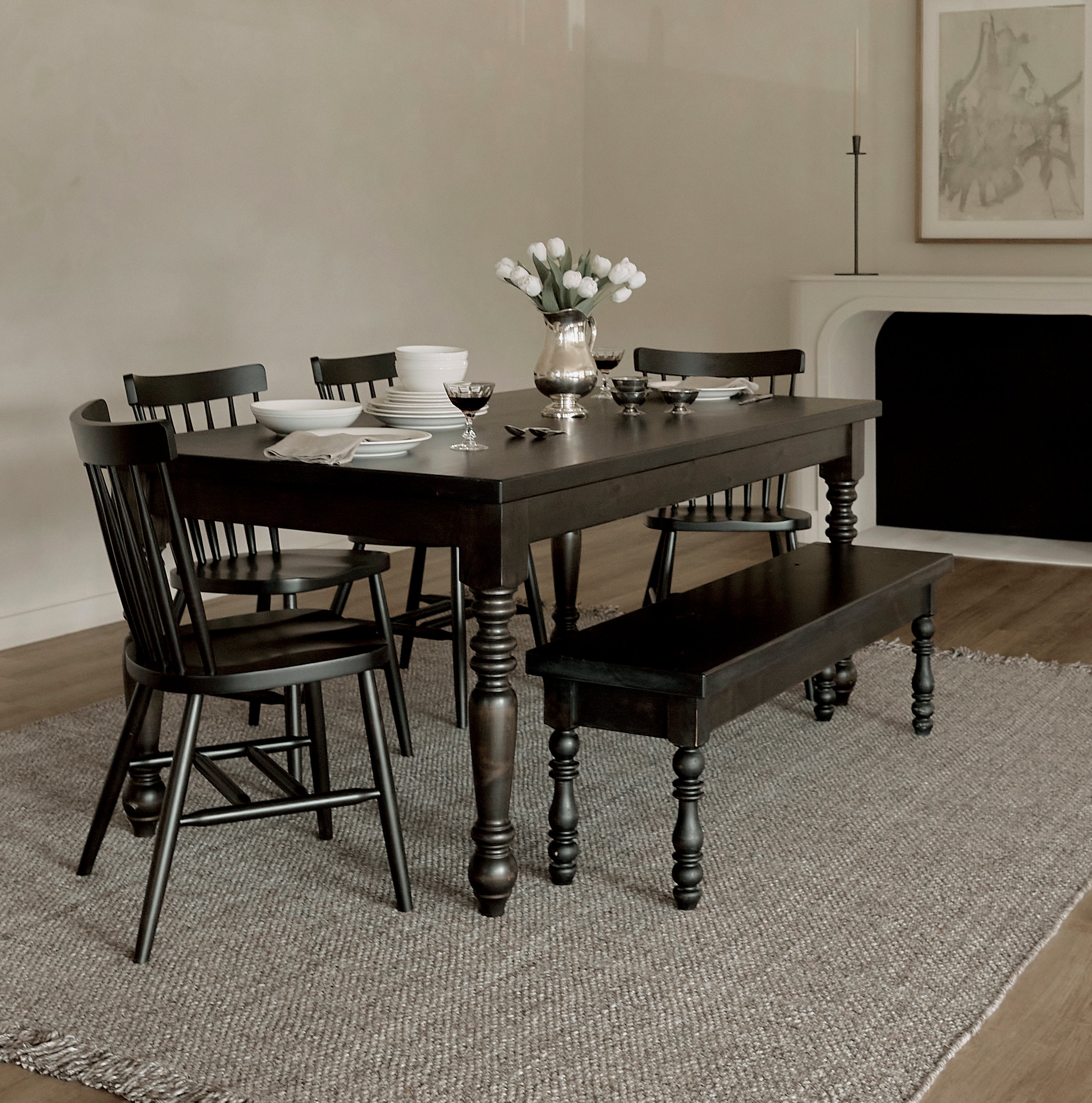
Square and round solid wood dining tables have something important in common: they bring people toward the center. Neither creates the long, linear arrangement of a rectangular table. Instead, each can make meals feel more shared, more conversational, and more connected to the room around it.
Their differences matter just as much. A square table gives the dining area a clear, tailored structure. Its straight sides can suit a room with strong symmetry and offer a familiar place setting arrangement. A round table softens the room, removes corners from the path of travel, and can make a compact gathering area feel more relaxed.
The best choice depends on the room’s proportions, the number of people you seat most often, and the way you want the dining area to feel in everyday life. Explore our square dining tables and round dining tables as you compare the decision below.
Begin With the Shape of the Room
The shape of the room is often the clearest starting point. A square dining room does not require a square table, and a round table can look beautiful almost anywhere. But the relationship between the table and the room determines whether the space feels balanced or awkward once chairs, people, and daily movement are included.
A square table often feels particularly natural in a room that is close to square. Its sides echo the room’s proportions and can make the dining area feel centered and composed. A round table can bring a softer answer to the same room, especially when the surrounding architecture, cabinetry, or furniture already contains many straight lines.
The most useful test is a full-scale one. Mark the tabletop footprint on the floor, then add the chairs you expect to use. Walk around the arrangement. Open nearby doors. Imagine serving a meal and passing behind a seated guest. The right shape will leave the room feeling usable, not merely mathematically possible.
When a Square Dining Table Is the Better Choice
A square table can offer a deeply satisfying sense of balance. It gives every side equal importance and creates a straightforward arrangement for guests. In the right room, that symmetry makes the entire dining area feel calm and intentional.
Square tables create a clear, shared center
At a square table, everyone is within a relatively similar distance of the center. That can make a meal feel connected, especially for a smaller group. The form is structured without being distant: four people can sit face to face, and a larger square can still create a sense of mutual presence around the table.
This is part of the appeal for homeowners who want the table to feel like a true center of the room. A square top can anchor a square rug, sit naturally beneath a central light fixture, and create an arrangement that looks considered from every side.
A good fit for rooms with balanced proportions
In a room that has roughly equal length and width, a square table can use the central area effectively. A long rectangular table might leave the room feeling empty at the ends or constrain the side paths, while a square form fills the room more evenly.
That does not mean a square table is automatically right for every square room. As its dimensions increase, it grows outward on all four sides. The room still needs enough space for chairs and circulation. A table that fits at the center but makes the perimeter difficult to navigate is not the right size.
Consider how a square grows with the guest list
Square tables can be generous for a close-knit group, but they require careful planning when you want to seat more people. A larger square top increases in both length and width, which means the room needs to support a more substantial footprint in every direction.
If you regularly host a crowd, compare the actual dimensions, base style, and chair placement before assuming a larger square is the simplest answer. In some rooms, a round table or an expandable design may create the flexibility you need with a different visual effect.
When a Round Dining Table Is the Better Choice
A round table can make a dining area feel immediately approachable. With no corners and no head of the table, it creates a natural sense of equality among guests. Everyone faces toward the center, conversation can flow easily, and the room often feels softer around the table’s edge.
Round tables are naturally conversational
For smaller groups, a round table can create an especially intimate arrangement. No one sits at the far end, and everyone can see one another without the visual distance a longer shape can create. That makes round tables a favorite for households that value lingering meals, coffee with friends, and a dining area that feels relaxed rather than formal.
The warmth of a round table does not come from the shape alone. Its diameter, base, chairs, wood, and finish all contribute. But the circular form gives the gathering a different starting point: shared rather than linear.
Curved edges can help where people pass nearby
In a compact room or open-plan dining zone, the absence of corners can make movement around the table feel easier. A guest walking toward the kitchen, a child passing through the room, or someone moving a chair does not need to navigate a hard corner at the end of the tabletop.
This can be useful where the dining area sits along a natural path between rooms. It does not eliminate the need for clearance, of course. A round table still needs room for chairs and walkways around its full perimeter. But the curve can make the path feel more forgiving once the size is right.
Diameter matters more than people expect
A round table expands into the room in every direction. That can make it feel perfectly proportioned in a balanced room and too dominant in a narrow one. Before choosing, mark the full diameter on the floor and include chairs in the test.
James & James offers round dining tables in a range of diameters and base styles. Compare the product-specific details against your room, especially if you are deciding between a pedestal and a legged table. The base can change how flexibly guests can sit around the perimeter.
Compare Seating and Chair Placement
Both square and round tables can support a warm, shared meal. The difference is how their edges and bases interact with chairs.
A square table creates distinct sides, which can make place settings and chair positions feel clear. Depending on the design, the corners may influence where guests can sit most comfortably. A round table has a continuous perimeter, which can feel more flexible around a pedestal base but still needs enough room for each chair to be used without crowding the next.
Look at the table base, not only the top
The base affects everyday comfort. A pedestal can open up the perimeter of a round table, allowing chairs to be positioned more flexibly. A four-leg square table may offer the classic look you prefer, but its legs will help define the seating arrangement. The apron, support structure, and under-table clearance matter too.
When comparing options, review the product specifications for the exact table. Overall dimensions tell you the footprint; the construction details tell you how the table will feel once everyone is seated.
Plan for your ordinary guest count
It is easy to picture a table at maximum capacity, especially when you are investing in a piece intended for years of family life. Start with ordinary meals instead. How many people sit there most nights? How much space do they prefer? Does the table also serve as a place for homework, laptop work, or projects?
The right table should be welcoming when only the household is home. If larger gatherings are important but less frequent, an expandable option may be more useful than choosing a permanently oversized top.
Think About Traffic Flow at the Busiest Time of Day
The better shape is often the one that protects the room’s natural movement. Test the layout at the moment it will be most demanding: chairs pulled back, guests seated, someone carrying food from the kitchen, and a path needed through the room.
Square tables need room on all four sides
Because a square table has straight edges and corners in each direction, it asks for a fairly even amount of open space around it. In a balanced room, that can feel wonderful. In a room where a doorway or main path runs close to one side, it may feel more demanding.
If your room naturally gives the table equal breathing room, a square can be a beautiful fit. If one or two sides need to remain open for circulation, a round table may make the arrangement feel easier.
Round tables can soften a central dining area
In an open dining area, a round table can create a gentler transition between zones. It gives people room to move around the table without the strong directional line of a square or rectangle. This can be particularly appealing in homes where the dining space is visible from several rooms.
Again, the size must be right. A large round table in a narrow dining zone will still crowd the room. Shape refines traffic flow; it cannot solve a dimension problem on its own.
Let Style Follow the Practical Choice
Once you know which footprint fits, let the design details make the table your own. A square table can feel traditional, farmhouse, modern, or transitional depending on its base, top, wood, and finish. A round table can feel equally versatile: a pedestal may bring classic presence, while a cleaner silhouette may feel more contemporary.
James & James dining tables are made to order in solid hardwood, with size, stain, and finish choices available by design. Use that flexibility to resolve the practical needs of the room first. Then choose the material and details that make the table feel at home with your flooring, cabinetry, chairs, and light.
If you are deciding between finishes, view real wood samples in the room. The same wood tone can feel very different beside your floor or under your dining-room lighting, and the right sample can make the final shape decision feel even clearer.
Questions to Ask Before You Choose
Before deciding between square and round, ask:
- Is the room close to square, or does it have an important path on one side?
- How many people will gather at the table most often?
- Does the table need to feel structured and symmetrical, or softer and more flexible?
- Where will chairs sit, and how does the base affect their placement?
- Can people move around the full perimeter with chairs in use?
- Would a larger fixed table feel right every day, or would an expandable option serve us better?
- Have we marked the full table and chair footprint on the floor?
The answer should feel visible once you see each shape in the room. The right table will bring people together without making the room work harder.
Find the Shape That Fits the Way You Gather
A square dining table can give a balanced room a clear, grounded center. A round table can create an easy, conversational gathering place with a softer edge. The best choice is the one that supports your everyday life and leaves the room with space to breathe.
Explore our square dining tables and round dining tables to compare the shapes, dimensions, and finishes that fit your home.
Consider reading Farmhouse vs. Modern Dining Tables: Which Style Is Right for Your Home?
Frequently Asked Questions
Is a square or round table better for a square room?
Both can work beautifully. A square table echoes the room’s symmetry and creates a structured center, while a round table softens the same space and can make circulation feel more relaxed. Test the full footprint with chairs before deciding.
Which shape is better for conversation?
Both bring guests toward the center, but a round table has no corners or head seats, which can make a smaller gathering feel especially connected. A square table can be equally conversational when its size keeps everyone comfortably within the same conversation.
Can a round table seat more people than a square table?
It depends on the dimensions, base style, and room layout. A larger round table uses space in every direction; a larger square table expands along four straight sides. Compare the exact footprint and chair placement rather than relying on shape alone.