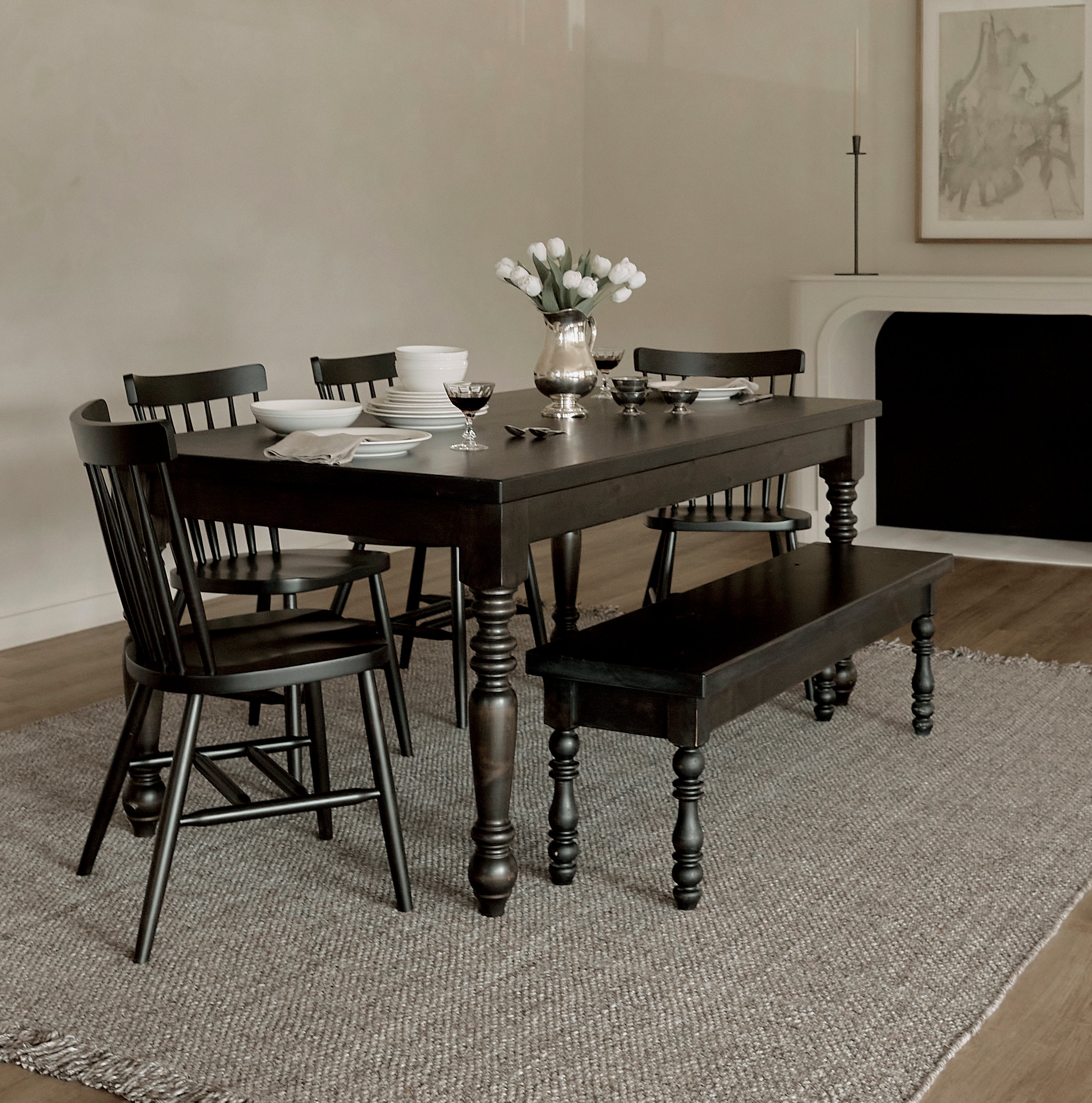
An oval solid wood dining table and a rectangular dining table may offer similar seating potential, but they change the room in different ways. A rectangle gives the dining area structure, direction, and a more traditional sense of order. An oval keeps much of that useful length while softening the edges, creating a gentler shape for rooms where movement and visual flow matter.
The right choice is not about choosing the more formal or more casual option. It is about choosing the footprint that works with your home: the way people walk through it, the number of guests you welcome, the shape of the room, and the atmosphere you want around the table.
As you compare, explore our oval dining tables and rectangular dining tables. Both shapes can become a lasting center of the home when their proportions are right.
Start With the Room’s Natural Lines
The dining table should work with the architecture of the room rather than fight it. Look at the longest wall, the path from the kitchen, nearby doorways, windows, and the furniture that needs to live around the table. Then ask which shape will make that space feel more settled when chairs are occupied and people are moving through it.
A rectangular table follows a clear line. In a long room, it can feel immediately at home, giving the space purpose and visual structure. An oval table also has length, but its curved ends soften the transition from table to walkway. That can be especially useful in an open-plan dining area or a room where people regularly pass the ends of the table.
Neither shape needs to mirror the room exactly. A well-proportioned oval can look beautiful in a formal dining room; a rectangular table can make an open-concept room feel anchored. The difference is in the relationship between the tabletop’s edges and the paths people need to use every day.
When a Rectangular Dining Table Is the Better Choice
A rectangular table is often the natural answer when the room is longer than it is wide and the dining area has a defined purpose. Its straight sides make seating clear, its ends can add useful places for guests, and its shape can create a strong visual center beneath a linear chandelier or within a formal dining room.
Rectangles give a longer room structure
In a long, narrow room, a rectangular table can make use of the available length without leaving the ends of the space feeling unconsidered. It creates an orderly arrangement for chairs, a rug, and lighting, and it can make the room feel intentionally designed rather than simply filled.
The key is to respect the table’s width. A rectangular table that is too wide can leave the side aisles tight; a table that is too narrow may not offer the presence or serving space you want. Mark its full footprint on the floor, including chairs, before you decide on dimensions.
Rectangles are easy to plan for larger dinners
For many households, the rectangular form feels intuitive for hosting. Guests can sit along both sides, the center of the table is easy to share, and the longer shape naturally accommodates a larger gathering. Depending on the base and dimensions, the ends can provide additional seating as well.
That does not mean a rectangular table is only for a crowd. A smaller rectangle can be warm and intimate. But if you often picture a longer dinner, shared platters, or a room designed to receive family and friends, a rectangle may give you the most straightforward plan.
Consider corners as part of the layout
The corners of a rectangular table are neither a flaw nor an afterthought. They are part of the design. In a dedicated dining room with room around the perimeter, they provide a crisp, architectural outline. In a compact or high-traffic area, those corners can become the places people need to navigate around most carefully.
If a doorway, island, or main path runs close to one end of the table, that is a signal to test the layout at full scale. The table may still work beautifully, but the room needs to have enough room for that shape to feel gracious rather than obstructive.
When an Oval Dining Table Is the Better Choice
An oval table can be a thoughtful answer when you want the seating and length of a rectangular table but prefer a softer relationship with the room. Its long sides retain the useful direction of a rectangle; its curved ends make the table feel less abrupt from the doorway and can make circulation around it feel more natural.
Ovals soften a linear room
In a longer dining room, an oval table can preserve the sense of length while adding visual ease. It can keep a formal room from feeling overly rigid, or make a traditional room feel a little more relaxed without sacrificing scale.
The shape is particularly appealing when the dining room connects directly to a kitchen, living room, or hallway. As people move past the ends of the table, the curve can make the path feel less abrupt. This is not a substitute for proper clearance, but it can change the way the room feels in daily use.
Ovals can make a large table feel more inviting
A large tabletop naturally carries visual weight. On a rectangular table, that weight is expressed through straight lines and defined corners. On an oval table, the same general scale can feel more welcoming because the form is less angular.
For homeowners who want room for guests but do not want the dining table to feel too formal or imposing, an oval can offer a lovely middle ground. It retains the usefulness of a longer table while bringing a more conversational, relaxed character to the room.
The curved ends still need real room
An oval is not a smaller rectangle. Its ends may be easier to move around, but the table still needs enough length, width, and chair clearance to function well. Do not assume that the curve automatically makes it suitable for a tight room.
Mark the full dimensions on the floor and add the chairs you intend to use. Walk through the room at the busiest point of the day. If the curve makes the route feel more natural while the seating remains comfortable, the oval may be doing exactly what you need it to do.
Compare Seating and Hosting Needs
Both shapes can accommodate everyday meals and larger gatherings. The more useful distinction is how the seating feels and how the room supports it.
A rectangular table gives a familiar arrangement: guests along the long sides, possible seats at the ends, and a clear centerline for serving. An oval table has the same general direction, but its curved ends can make the end places feel different and may alter how chairs sit around the perimeter.
Before deciding, consider the number of people you host most often, not only the maximum number you could fit. A table should be generous enough for the gatherings that matter without making the room feel crowded on ordinary days.
Think about everyday meals and special occasions separately
If the dining table is used by a small household during the week but needs to welcome a larger group for holidays, an expandable design may be worth considering. James & James offers expandable dining tables in a range of forms, allowing the room to remain proportioned for daily life and expand when it needs to.
Whether the table is fixed or extendable, plan for its largest useful configuration. A table only solves a hosting problem if people can still move around it comfortably when every seat is in use.
Let Traffic Flow Make the Final Decision
When both shapes appeal to you, traffic flow is often the deciding factor. Look at the path people will take when they enter the room, carry a meal from the kitchen, move toward a doorway, or walk behind seated guests. That route is more important than a style label.
Rectangular tables need clear side aisles and end space
Rectangular tables work best when the room can give them straightforward space along their sides and at their ends. In a long room, that can be a very natural arrangement. In a narrower or more open area, it may mean that the corners sit too close to a doorway or a main path.
This is not a reason to rule out the shape. It is a reason to test it honestly. If the room feels calm with chairs pulled out and guests moving around, the rectangle is likely a strong choice.
Oval tables can make a path feel more forgiving
The rounded ends of an oval can soften a route through the room, particularly where people pass near the table. In an open-concept home, this can make the dining area feel less like a barrier between the kitchen and living space.
But a curve cannot create space that does not exist. If the table is too large, the room will still feel crowded. Choose the size first, then use the shape to refine how the room feels around it.
Consider the Visual Mood You Want
The practical fit should lead the decision, but the visual mood matters too. A dining table is a daily presence. Its shape will influence whether the room feels structured, tailored, soft, relaxed, formal, or quietly traditional.
Rectangular tables feel tailored and architectural
Straight lines can give a dining room a sense of order. A rectangular table often works beautifully beneath a long chandelier, alongside a sideboard, or in a room with strong architectural symmetry. Depending on the base, wood, and finish, it can be rustic, traditional, modern, or transitional—but it usually retains a clear, grounded presence.
Oval tables feel softer without losing substance
An oval table can soften a room filled with straight edges: windows, cabinetry, flooring, and built-ins. It can also make a formal dining room feel more approachable. The shape is still substantial, particularly at a larger scale, but its curves invite a different kind of ease.
Neither mood is more timeless than the other. Choose the one that feels most like the home you are creating, and let the wood, finish, chairs, and lighting complete the picture.
Questions to Ask Before You Choose
Before deciding between an oval and a rectangular dining table, ask:
- Is the room long, narrow, open to other spaces, or more enclosed?
- Where do people need to pass when chairs are in use?
- Does a corner sit near a doorway, island, or main walkway?
- How many people do we seat every day, and how many do we host regularly?
- Does the room need the formal structure of a rectangle or the softer flow of an oval?
- Have we marked the tabletop and chair footprint on the floor?
- If the table extends, have we tested the expanded size as carefully as the everyday one?
You do not need to choose the shape that seems safest in theory. Choose the one that makes the room feel easier to live in.
Find the Shape That Fits Your Home
An oval table can bring a softer edge to a longer room and make movement feel more natural. A rectangular table can give the same room clarity, structure, and generous seating. The right one is the table that makes gathering feel easy from the first meal to the largest celebration.
Explore our oval dining tables and rectangular dining tables to compare the shapes, proportions, and finishes that fit your home.
Consider reading Why Solid Wood Dining Tables Last for Generations
Frequently Asked Questions
Is an oval dining table better for a narrow room?
It can be, especially when the curved ends improve the path around the table. But the overall width, chair placement, and clearance still matter. Mark the full footprint before deciding.
Can an oval dining table seat as many people as a rectangular table?
Both can accommodate larger groups, but they arrange guests differently. Compare the product-specific dimensions, base style, and chair placement rather than judging by shape alone.
Does an oval dining table look less formal than a rectangular table?
Not necessarily. An oval can be refined and substantial, just as a rectangle can feel relaxed. The wood, finish, base, chairs, and room architecture have as much influence on formality as the tabletop shape.