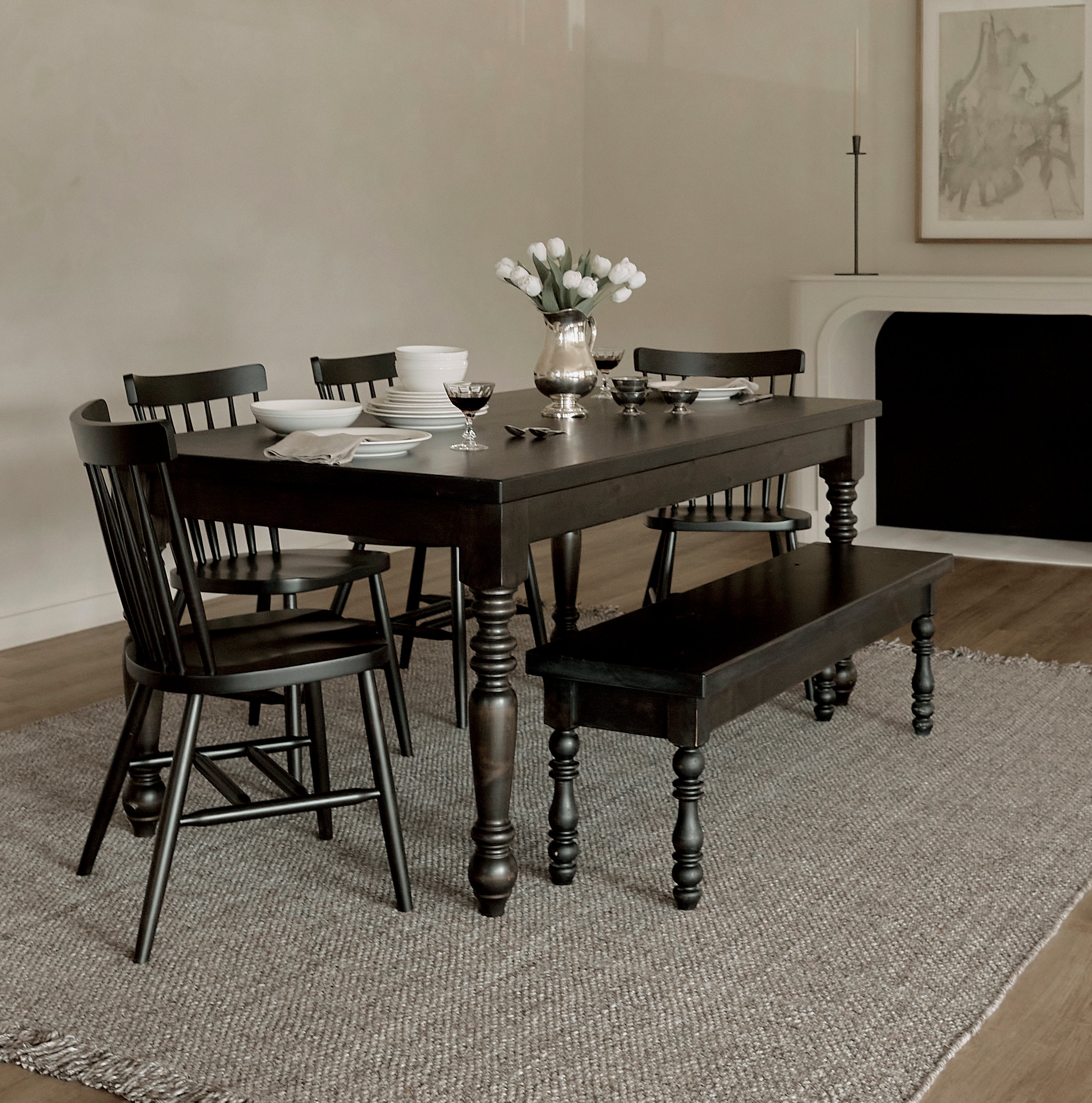
A round dining table creates a particular kind of gathering. There are no head seats, no corners, and no long sides that separate one part of the table from another. Everyone shares the same center.
The chairs should support that feeling. They need to fit the table’s curved perimeter, work with its base, and leave enough room for people to move naturally around the dining area. The right chairs can make a round table feel intimate and generous; the wrong ones can make a room feel crowded even when the table itself is a good size.
Start by exploring dining chairs, then compare the exact chair dimensions with the diameter, base, and room around your table.
Start with the Table Diameter and Chair Width
Around a round table, every chair shares the same edge. That makes chair width an especially important part of the plan.
Map the usable perimeter
Do not begin with a generic seat count. Begin with the actual diameter of your table and the actual width of the chairs you want. A slender wood side chair and a broad upholstered armchair will create very different arrangements around the same circle.
Place the likely chairs around the table at full width. Each person should have a comfortable place to sit without chair arms or edges constantly meeting. The goal is not to use every possible inch of perimeter; it is to make the table feel welcoming when everyone is seated.
Include the chair depth too
Chair width is only part of the story. Depth determines how far the seating reaches into the room when tucked in and how much farther it moves when someone sits down. A table can accommodate the desired number of chairs around its edge and still be wrong for the room if the chairs block a doorway or main path.
Map both positions before ordering. The dining set should work when people are eating, not only when chairs are pushed neatly under the table.
Let the Base Guide the Seating Plan
The base has a real effect on how flexible a round-table arrangement can be.
Pedestal bases can keep the perimeter open
A pedestal base can make chair placement more adaptable because there are no four corner legs at the table’s edge. This may be particularly helpful if you occasionally add a guest, use a mix of chair types, or want the chairs to feel evenly placed around the circle.
The base still has a footprint. Look at where it meets the floor and consider how feet, chair legs, and dining habits will relate to it. A well-planned pedestal table should allow chairs to approach naturally without the base becoming an unexpected obstacle.
Legged round tables need more specific positions
A round table with legs can be beautiful and stable, but the legs will establish natural seating zones. Plan chairs between the supports rather than assuming every point around the circle works equally well.
That may influence the number of regular seats, where an extra chair can go, or whether a specific chair style is appropriate. Use the exact table configuration as the guide.
Choose Chair Types for the Shape of the Gathering
Round tables often make people feel more connected, and chair choice can reinforce that quality.
Side chairs can keep the arrangement easy and flexible
Side chairs are often a natural match for a round table because their armless profile can fit around the curved edge without introducing extra width at every position. They can also be easier to adjust when the guest list changes.
This does not mean every round table needs identical side chairs. A tailored upholstered side chair or a wood chair with a sculptural back can bring substantial character while preserving a lighter perimeter.
Armchairs can add comfort when the room allows
Armchairs can work beautifully around a round table, especially when a pedestal base and room clearance support their larger footprint. They can make an intimate dining area feel richly comfortable and give the table an inviting, lounge-like quality.
The question is whether the room can hold their width and depth at every seat. In a smaller dining area, a pair of armchairs may be more practical than using them all the way around. Measure the arms against the table underside if tucking is important.
Keep the Arrangement Balanced from Every Angle
Unlike a rectangular table, a round table is usually viewed as a complete composition. There is no obvious head or end to hide a mismatch.
Repeat a clear visual idea
Matching chairs are one way to create balance, but they are not the only way. If you mix chairs, repeat something that makes the relationship clear: a common wood tone, similar seat height, related upholstery, a matching pair, or a consistent visual weight.
For example, two upholstered armchairs can be balanced with four wood side chairs when the fabric, wood, and scale speak to one another. A random mix of several unrelated chair forms may feel unsettled because every seat is equally visible around the circle.
Consider chair-back height
Varying back heights can be beautiful, but they should create a deliberate rhythm. Stand at the room’s entry, kitchen, and adjoining living space to see how the chair backs frame the table. The round shape often makes this view more important because the arrangement is read from every direction.
If one chair feels dramatically taller or heavier than the others, either give it a clear role as part of a pair or choose a gentler contrast.
Make Room for Conversation and Movement
The central appeal of a round table is closeness. The room still needs to allow people to arrive, leave, and pass with ease.
Test the full circle of pulled-out chairs
Use painter’s tape, boxes, or chairs you already own to map the table and every seat. Pull each chair back to its likely dining position. Then walk around the entire circle, not just the most convenient side.
Check paths to the kitchen, nearby doors, and the rest of the home. The room does not have to be empty around the table, but people should not have to turn sideways or ask others to stand every time they move.
Plan for guests with intention
If you add a chair for a larger meal, identify where it will go before guests arrive. A pedestal base may allow more flexibility, but the extra chair still needs a comfortable width and a route into the table. Consider where it will live on ordinary days too.
If your round table expands into an oval, test both forms. The open table may create end seating and a different chair arrangement than the closed circle.
Choose Materials for the Room’s Mood
The chair material can shape the tone of a round dining arrangement.
Wood chairs can emphasize the table’s natural warmth
Wood chairs can create a cohesive, enduring setting around a solid wood round table. They may be the right choice when you want the room to feel structured, tactile, and grounded in natural materials. Complementary finishes often look more layered than an exact match.
Wood can also keep the perimeter visually open, depending on the chair’s back and frame. This can be especially helpful in a compact dining room or near large windows.
Upholstery can soften the circle
Upholstered chairs add softness around the curved table and can make a round dining area feel more relaxed. Choose fabric and color in relation to the room, not only the chair. Look at the rug, drapery, walls, and any nearby living furniture.
James & James offers upholstered dining-chair options alongside wood styles. Confirm current materials, dimensions, fabric options, and care instructions for each selected design before ordering.
A Simple Planning Process
Before making a final choice:
- Measure the table diameter, underside clearance, and base footprint.
- Collect the exact width, depth, seat height, and arm height for each chair.
- Map all chairs around the table when tucked in and pulled out.
- Test the routes around the dining area and into the rest of the home.
- Look at the arrangement from every adjoining room.
- Add any guest chairs or extended-table configuration to the same test.
This process reveals whether a chair will simply fit or truly belong around the table.
Browse dining chairs with that plan nearby, and choose the arrangement that makes the round table feel easy to gather around.
Or, learn How to Choose Dining Chairs for a Rectangular Table.
Frequently Asked Questions
What kind of chairs work best with a round dining table?
The best chairs fit the table’s diameter, base, and the room around it. Side chairs often offer flexibility; armchairs can add comfort when their width, depth, and clearance work with the layout.
Can I use armchairs around a round table?
Yes. Confirm their width and depth around the full perimeter, their arm clearance beneath the table if needed, and the room’s circulation with chairs pulled out.
How do I mix chairs around a round table?
Use a balanced plan. Repeat a clear connection such as a matching pair, related seat height, wood tone, upholstery, or visual weight so every chair feels part of the same arrangement.
Do pedestal tables make chair placement easier?
A pedestal can create more flexibility around the edge because there are no corner legs. The specific base footprint and chair dimensions still need to be tested together.